
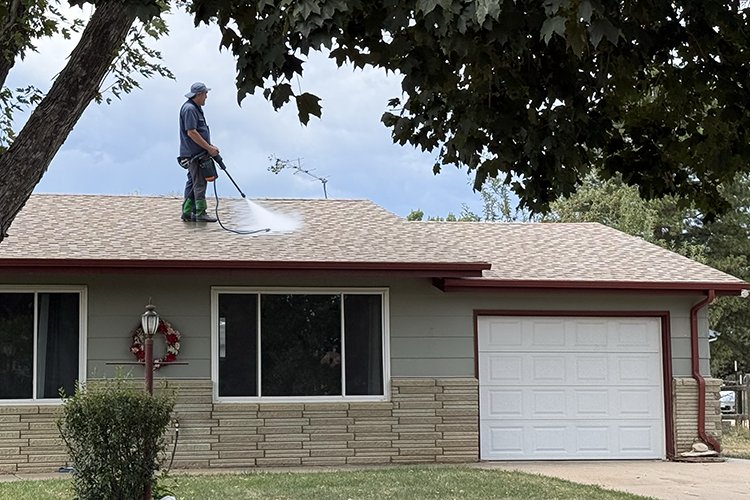
Replacing your roof isn’t cheap or convenient. Even on a somewhat small house, replacing a roof with cheap 3-tab shingles on a moderately difficult roof will still cost between $10,000 and $15,000. We can’t blame someone for looking for ways to extend the life of their asphalt shingle roof. But is Roof Maxx worth it?
What Is Roof Maxx
Roof Maxx is a soybean oil–based roof treatment for aging asphalt shingles that’s applied to help restore flexibility (and the shingle’s moisture resistance), with the goal of extending the roof’s life. It’s marketed as adding up to 15 years to the life of unbroken, well-conditioned asphalt shingles. It’s a real product with real chemistry, but with meaningful limits.
Ohio State University lab testing commissioned around the product found that treated shingles regained significant flexibility and improved granule adhesion. So there’s genuine science behind the concept, not pure snake oil.
What it Can’t Do
• It won’t fix an already-leaking roof, can’t restore areas with significant granule loss, and won’t flatten shingles that have physically curled – that damage is permanent.
• Results are hard to verify yourself since the treatment works inside the shingle, invisible to the homeowner – you’re mostly trusting the salesperson and process.
The catch: the company markets each application as adding roughly five years of roof life, repeatable, for about a fifth the cost of replacement – but it’s not a miracle fix, and quality varies a lot depending on which local dealer franchise shows up at your door, since Roof Maxx is sold through independent franchises.
How Much Does Roof Maxx Cost?
Compared to a full roof replacement, it typically costs 15–20% of the full roof replacement cost – replacement often runs $10,000–$15,000+ for asphalt shingles. $1,500 – $3,000.
What affects the price:
• Roof size and pitch (steeper = more labor)
• Number of applications (up to 3 treatments over time, each adding ~5 years)
• Accessibility, regional labor rates
• Prep work — if there’s moss removal or other cleanup needed, the cost can climb (one case study saw prep push the total to $7,000–$9,000). At that point, you might as well replace your roof, and Roof Maxx might not be worth it.
Get a few quotes since dealer franchises price independently, and confirm the quote is fixed-price with no hidden fees for extra treatment cycles or access issues.
Does It Affect Home Resale Value
• It’s not a real substitute for a new roof. Appraisers and savvy buyers’ inspectors generally recognize Roof Maxx as a maintenance treatment, not a roof replacement – it doesn’t reset the shingle’s manufacture date or change the roof’s actual age. A full replacement recoups roughly 60-70% of its cost at resale specifically because it delivers a genuinely new roof; Roof Maxx doesn’t have that same track record of appraised value increase. In this case, Roof Maxx might not be worth it.
• Disclosure matters. If you treat the roof to make it look better for sale, and a buyer’s inspector or roofer identifies the treatment (or the roof’s true age via permits/records), it can read as trying to mask an aging roof rather than adding value – which can hurt trust in negotiations.
• Some manufacturer shingle warranties can be voided or altered by third-party treatments, which is a red flag for buyers’ inspectors and can complicate the sale rather than help it.
Roof Maxx is best framed to a buyer as “we maintained this roof and extended its life for X more years, with a transferable warranty” – not as “this is a new roof.” It’s a reasonable move if your roof is aging but sound, and you want to avoid a full replacement before selling, but don’t expect it to add value the way an actual roof replacement does. Be upfront about it in disclosures; buyers tend to react well to honesty about maintenance history and poorly to anything that feels like a roof was “dressed up” to pass inspection.
Bottom line: Roof Maxx is genuinely useful for one specific situation – an aging but still structurally sound (no granular loss or curled or cracked shingles) roof where you want to buy a few more years before replacing it. It’s not a universal substitute for replacement, and some franchise operators reportedly push it on roofs that are either too new to benefit or too damaged to help. If a salesperson is pitching it, get an independent roof inspection first to confirm your roof is a good candidate – not too far gone, not too new to need it. See our list of Greeley roofing companies. Overspraying is a concern – soybean oil spray on your car, plants, pets, or anything else close to your house.